ASU SenSIP REU Site: Quantum Machine Learning Algorithm Design and Implementation
January 2024-December 2026 PI: Andreas Spanias, Co-PI: Jean Larson
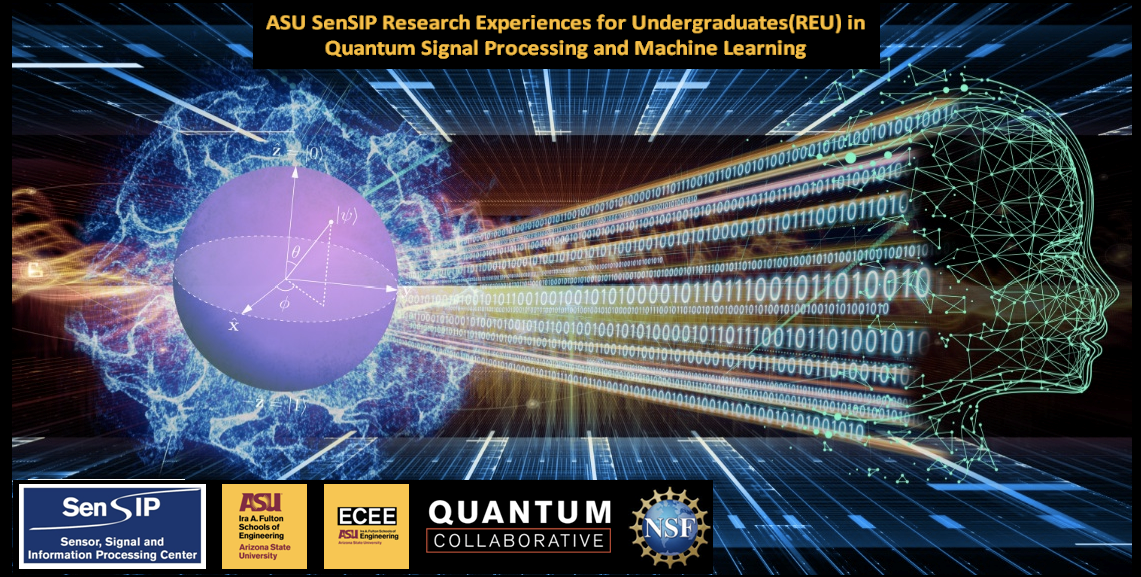
Abstract
General Description: Quantum Computing (QC) promises to accelerate information processing and solve highly complex data problems. This three-year REU site will recruit and train nine undergraduate students each summer and engage them in research endeavors on the design of quantum signal processing and quantum machine learning circuits and simulations. The investigators, along with a team of faculty advisors, will supervise a series of multidisciplinary research projects in quantum AI and quantum Digital Signal Processing (DSP). In addition to the planned REU projects, the investigators of this project will organize a series of industry-university collaborative training activities for the students. This REU features multidisciplinary synergies across different research labs that provide access to unique quantum simulation software, quantum physics and networking facilities, and quantum machine learning circuit design for several applications including health, sustainability, and security. Specific applications include audio recognition, image understanding, encryption and solar energy systems. The program will also include crosscutting professional development, modules and workshops in public speaking, policy, ethics, patent development and outreach. Annual REU workshops will train students to communicate with stakeholders. The investigator team will use the NSF Education and Training Application (ETAP) system for recruitment of REU student participants. Local and national evaluation units including the Center for Evaluating the Research Pipeline (CERP) will be deployed for assessments that will provide feedback for program improvement. Local site evaluators will also assess REU goals annually using feedback from student participants, academic and industry mentors, and other stakeholders.
Technical Research Description: The REU will address STEM problems associated with quantum information processing (QIP) and specifically quantum signal processing and quantum machine learning (QML). Key research and education problems include a) understanding the theory and statistics of Quantum bits (Qubits), b) introduction to quantum noise models, c) understanding of tradeoffs between Qubit precision and quantum noise, d) skill-building with programming quantum simulations, and e) laboratory access to unique QC facilities. The faculty investigators will organize project and mentorship activities including REU student mentorship by industry partners. The objectives of the proposed site are to a) introduce students to research practices by immersing them in government and industry projects, b) engage students in quantum machine learning research, c) motivate students to pursue QIP research careers and recruit them to graduate programs, and d) provide cross-cutting skills in presentation, ethics, and standards. The REU projects are designed to introduce students to an array of quantum information processing technologies that emphasize the design of quantum simulation circuits for: AI-based signal and data classification, signal analysis synthesis using the quantum Fourier transform, quantum cloud and edge computing, quantum networking, quantum image understanding, and quantum based encryption. During the same period, projects will train REU students to understand issues dealing with quantum noise and quantum precision, quantum bit (qubit) measurement methods and theoretical aspects of superposition and entanglement. The REU will achieve social impact through several mechanisms including cross-cutting training, workshops on public speaking and ethics, dissemination of quantum project results and outreach.
ASU Article: Students explore quantum computing for real-world impact
List and copies of Projects, Elevator Pitches, Posters from Summer 2026.
| Photovoltaic Fault Detection with Readout-Enhanced Quantum Machine Learning | Elevator Pitch | Poster |
| Quantum Generative Models for Tumor Segmentation Masks | Elevator Pitch | Poster |
| Using Hyperspectral Imagery and Quantum Neural Networks to Detect Harmful Algal Blooms | Elevator Pitch | Poster |
| SAS-Based Underwater Target Localization Using Hybrid Quantum Machine Learning | Elevator Pitch | Poster |
| Quantum Augmentation for Imbalanced Cancer Images Using Amazon Braket | Elevator Pitch | Poster |
| Quantum Machine Learning for Adaptive Noise Reduction | Elevator Pitch | Poster |
| Quantum Kernel Methods for Brain Tumor Classification Using Amazon Braket | Elevator Pitch | Poster |
| Quantum Neural Networks for Image Classification | Elevator Pitch | Poster |
List and copies of Projects, Elevator Pitches, Posters from Summer 2025.
| Quantum ML for Credit Card Fraud Detection | Elevator Pitch | Poster |
| Diagnosing Dysarthria by Leveraging Quantum Machine Learning | Elevator Pitch | Poster |
| Quantum Image Pre-Processing of MRIs for Improved Classification | Elevator Pitch | Poster |
| Quantum Positional Encoding for Neural Radiance Fields | Elevator Pitch | Poster |
| Quantum Enhanced 3D Gaussian Splatting | Elevator Pitch | Poster |
| Quantum Transformers for Image Generation | Elevator Pitch | Poster |
| MIDI Generation with Quantum Neural Networks | Elevator Pitch | Poster |
| A Quantum Approach to Music Source Separation | Elevator Pitch | Poster |
| Numerical Comparison and Utilization of Riemann Gradient Descent | Elevator Pitch | Poster |
The program is sponsored by NSF CISE REU Project Award 2349567
Publications:
- T. Patel, J. Larson, G. Uehara, N. Babar, D. Pujara, A. Spanias, A. Sharma, G. Uehara, V. Narayanaswamy, L. Miller, and A. Spanias, “ Training Students For Research With Quantum AI Simulation Tools,” Accepted ICASSP, IEEE International Conference on Acoustics, Speech and Signal Processing – 2026.
- S. Vittal, D. Ramirez, G. Uehara, G. DeLuca, A. Spanias, Quantum Generative Neural Networks for Imaging Application,” Generative Quantum Neural Networks,” IEEE IISA 2025, Mytilene, July 2025.
- C. Su, G. Vetaw, S. Jayasuriya, G. Uehara, A. Spanias, “Random Quantum Circuits as 3D Convolutional Kernels for 3D SAS ATR,” 16th IEEE IISA 2025, Mytilene, July 2025.
- Gabrielle Miller, Phillip Konstantinov, Glen Uehara, Guillermo J. Tearneyc, Andrew Thrapp, Chistos Photiou, Costas Pitris, Andreas Spanias , “Semantic segmentation and classification of OCT colorectal polyp images,” SPIE Photonics West, SPIE, San Franscisco, January 2025.
- T. Patel, D. Knutson, G. Uehara, C. Jazwin, F. Marfai, J. Larson, A. Spanias, “Image Analysis-Synthesis Using the Quantum Fourier Transform, Proc. IEEE ISCAS 2025, London May 2025.
- A. Sharma, G. Uehara, C. Wang, J. Larson, W. Barnard and A. Spanias, “Education Software Development for Undergraduate Exposition on the Use of Quantum Fourier Transforms in Signal Analysis,” in IEEE Transactions on Education, vol. 68, no. 5, pp. 474-483, Oct. 2025.
- J.S. Larson, D. Pujara, D. Ramirez, L. Miller, T. Patel, T. Babar, and A. Spanias, “WIP: Building a Research Experience for Undergraduates in quantum machine learning,” 2024 IEEE Frontiers in Education Conference (FIE), Washington, DC, USA, 2024, pp. 1-5, doi: 10.1109/FIE61694.2024.
10893516.
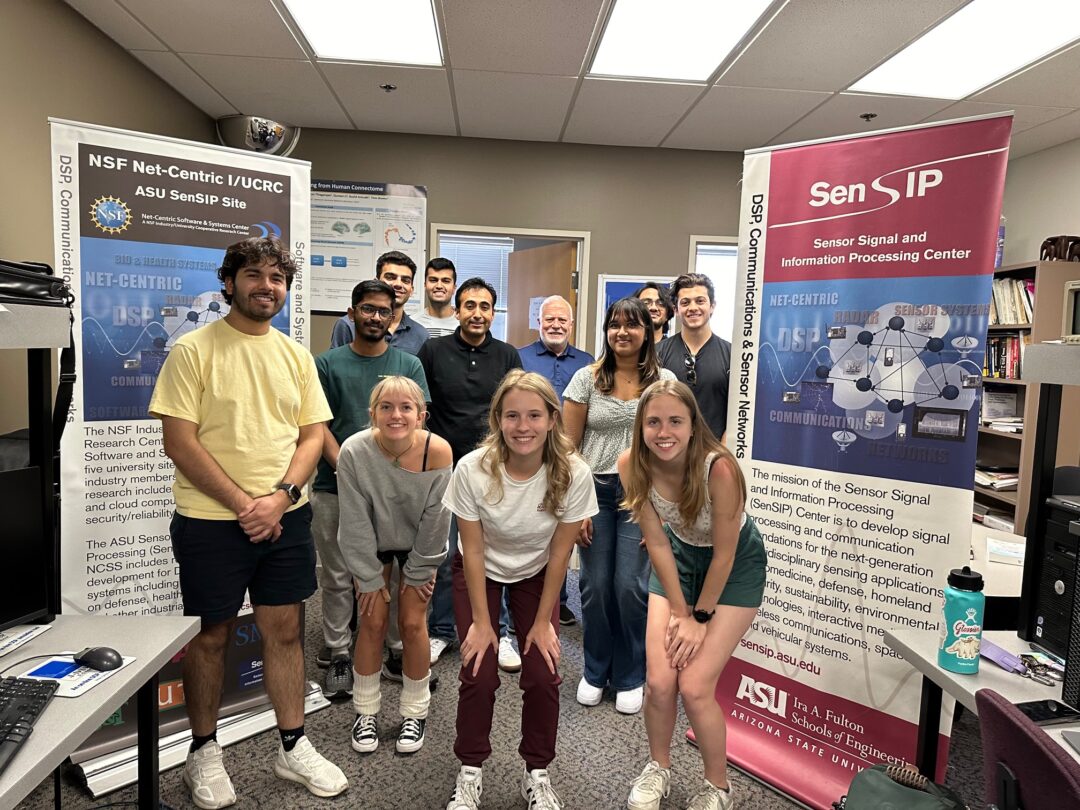
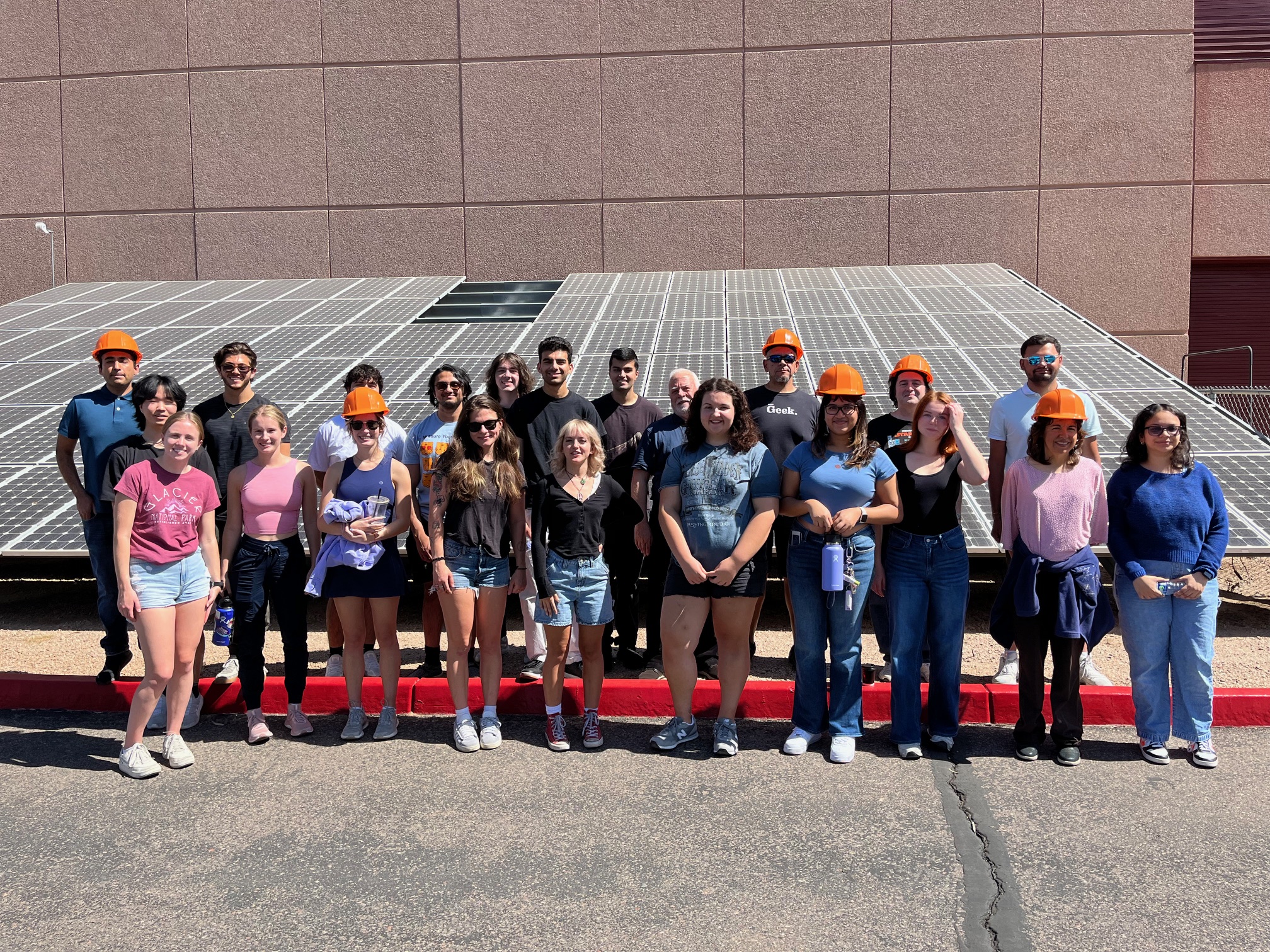
Photo Album from REU Presentations in June 2025
 |
 |